
PROCESS for Closing Open Loops That Fragment Your Mind
(Open Loops pt. 2)
Last week, we talked about how open loops fragment your mind and drain your energy. How they compound. How they build you an identity of someone who doesn’t finish what they start.
We saw how these open loops cost us way more than we realize, and why they’re worth closing.
This week we’re digging into the exact process I’ve been using to close my open loops, and am using right now to finally finish a huge violin live looping video project I started 6 years ago and left sitting at about 90% done. Less Than Three
If you’ve never had any problem finishing what you start, and for you it’s as simple as just working on a project until it’s done, then starting a new one, then good for you (sincerely). This post is not for you.
But if you’re like me, and periodically get all excited to finish stuff, then somehow get blown off course, and find yourself scratching your head months or years later, wondering what happened…
If you have tons of seemingly good ideas, but frequently change your mind about which is the priority…
If you constantly feel like a new idea is more important than what you’ve been working on, shift focus, and leave the rest unfinished…
Then this process, the related mindset shifts, and troubleshooting guide might help you find the clarity and structure you need to finish things like never before, and experience the satisfaction and mental defragmentation that comes with it.
I don’t master all this yet, but I’m stoked about how much I’m improving, and feel it’s a good time to share what I’m learning.
This whole process COULD be simplified down to just:
Determine the priority.
Work diligently on it until it’s done.
Repeat
There’s a reason I didn’t simplify it to just this kind of linear productivity advice.
This type of simple, no fluff, framework is helpful sometimes, but for many years I thought it should be that simple, so I felt even more discouraged when I somehow just couldn’t seem to follow through on something I truly wanted to finish, and intellectually knew shouldn’t be hard or complicated to complete.
This killed my self-confidence.
I struggled to diagnose the patterns of what kept going wrong, and why even frequent bursts of motivation weren’t getting me reliably across the finish line.
This process I’m giving is more expanded & multi-faceted.
It weaves together many layers of insights from my personal experience of what’s actually worked for me. Here’s the process overview to help us get oriented- just know that it initially reads like standard, obvious productivity advice and is not really that helpful without the details I’ll add in the next sections.
Process Overview :
1. Write Down All Open Loops
2. Assess them on various dimensions
3. Prioritize them
4. Commit to ONE (the right way, which only recently clicked for me)
5. Take step after step (while zooming in and out repeatedly)
6. Make the tough decisions
7. Make it through finish line (even when it seems the finish line keeps moving farther away).
+ Troubleshooting
The point of this detailed process is NOT to overcomplicate things, nor to slow us down from actually getting into the work.
On the contrary- breaking things down into more detail is ultimately meant to lead us back to that simplicity of just setting a priority and finishing it.
We’re taking this extra time on the front end to lay a more solid foundation.
We’re drawing out a more complete roadmap that helps us to stay on track.
We’re equipping ourselves with the tools to navigate the traps and road blocks that inevitably spring up in the process of finishing a big project.
We’re clarifying issues now, so we’re not knocked off course so easily when doing the work.
The total framework I’m providing is multi-dimensional, and involves a deep integration of practical steps, key mindset shifts, and troubleshooting problems.
The “multi-dimensional framework” is not because it sounds neat, or because I’m the ultimate expert, but because I was TERRIBLE at finishing projects for most of my life, and have finally been having huge breakthroughs, and wanted to distill down for myself and others what’s finally working.
As I’ve written about what’s working for me, I’ve discovered it’s a multi-dimensional framework, haha.
For organizational purposes- this post focuses mostly on the actionable process steps with a bit of troubleshooting and some of the mindset shifts woven into them.
Next week we’ll go more into some troubleshooting, and the following week we’ll go much deeper into the mindset shifts, which really make things click in a new way.
I thought about organizing this Open Loops mini-series in many different ways, but decided to move forward on it like this.
Just keep in mind that all 3 components (process, mindset, & troubleshooting) go together to enhance your clarity, sharpen focus, and build resilience for finishing the things that matter to you.
Last week, I suggested you start by making a list of ALL the open loops you have.
If you did this you might be sitting there looking at 30, 40, maybe 50 open loops and thinking “Where do I even begin?”
I feel you.
That was my situation for years.
I’m only recently breaking through.
I finished my first major work, KAN, in 2022, and that shifted something huge inside of me.
Now I’m cycling back to close open loops from years ago- to consolidate all that energy.
You Might Not Need This Whole Process (But Here’s Why It Helped Me)
If you already know which single loop is your priority -
if it’s crystal clear in your mind what one thing you need to close, and nothing else feels close-
you can skip ahead to step 4, or just start taking the next step…
But I found this full sorting process helps settle and focus my mind.
When I just try to focus on one thing without addressing all the others, my mind spontaneously pulls up another open loop. I’ll feel this sense of “Oh no, what about that? Is that getting done?” and I get distracted from what I’ve determined is the priority.
This sorting process gives everything a place. My mind feels secure that nothing important will slip through the cracks, because I’ve consciously seen and organized everything.
It also helps me see how everything connects. A lot of these projects seem different, but they’re all interrelated. They all connect back to the overarching vision of living a more harmonious reality inside and out.
You likely have a variety of different interests too, with a common thread running through them all to be discovered.
The sorting gave me clarity on how one thing might inspire others, while still maintaining focus on moving forward with one thing at a time.
So if you’re like me - if your mind keeps pulling you in different directions - this process might help.
Step 1: Write Down EVERY Open Loop You Can Think Of
Hopefully you made the list last week. If not, do it now.
Just write down every open loop you’re carrying.
Big or small.
Get down as many as you can think of, then leave the page open and go do other things. Almost certainly more open loops will surface in your mind- go jot them down as they do.
*If new or unstarted project ideas pop into your head, feel free to write them down too.
Step 2: Assess Each Loop on Three Dimensions
We’re going to now assess each loop on three dimensions:
Size: How much total work is required?
(Some are quick, some are massive)Importance: How important/inspiring is this to me?
(Some projects matter more than others.)Progress: How far along is it already?
A 90% done project might deserve priority over a more exciting 20% done project.
You can write all of these dimensions down if you want to be extra thorough, or just take a quick mental note of them.
Size: How big is this loop?
Micro loops can be closed quickly - responding to a text, paying a bill, sending an email, organizing a folder. These might take 30 seconds to an hour.
Macro loops require sustained effort over time - projects with many steps, creative work, things that need multiple sessions to complete.
Mini loops are somewhere in between.
This distinction matters because you might have 20 micro-loops you can close in a single focused day, freeing up massive mental bandwidth for the one big loop that requires sustained focus.
I’d recommend taking a day or two this week to knock out as many micro-loops as you can. Just clear the clutter. Free up space.
Gain confidence in your ability to finish things.
Lots of productivity people talk about this, so I’ll leave it at that for now about the micros.
I’m currently in the process of closing my macro loops, the big ones that have been open for months or years, so that’s the primary focus of this post.
Importance:
Was this a fleeting nice sounding idea?
Or is it a project knocking deep within my heart?
Does this really inspire me?
I may have gotten tired of the process, but is the vision still inspiring?
Does this feel like a meaningful step?
Do I feel people will benefit from this?
Will it move my skillset or career forward?
(We obviously can’t say for sure- but what’s my intuition about this?)
Progress: How Far Along Is It Already?
Some projects might not be high priority in terms of excitement. But they’re 90% done. That means all that work is sitting in a folder doing absolutely nothing for you, or anyone, until it’s released.
The final 10% might actually be quick work- maybe it’s just a few tough decisions, mastering, album art, and uploading. That could move it up the list, even though it wouldn’t otherwise be a high priority.
How much work have I already put in that’s doing absolutely nothing for my career or the world because it hasn’t gotten through those last steps?
Sometimes the answer is: “A lot, and I could knock out that final stretch relatively quickly.”
Maybe it’s a macro-loop, but at this point it just requires the effort of a mini-loop in order to close the whole thing, release it to the world, and free up all that bandwidth.
(Less Than Three <3 was this exact progress situation for me+ High Importance.)
That changes the calculation.
Step 3: Sort Into Five Priority Buckets
With the above three dimensions in mind, sort your loops into 5 Buckets.
Now we’re sorting by priority, from:
“definitely NOT doing this” ← → “actively closing this right NOW.”
I use five categories:
1. NOT Going to Finish
Make the conscious decision to let it go with no plan or intention to pick it back up in the future.
This might hurt, but it’s liberating. That project from 2010? Maybe it’s just not happening. And that’s okay.
Making a conscious choice - even a choice to NOT finish something - closes the mental loop.
Your mind stops tracking it. It’s resolved, even if it’s resolved by abandonment.
2. Someday Maybe
There’s nice stuff here that you’d maybe like to salvage at some point, but it’s not the priority for the foreseeable future.
Close it off from your mind until you do this open loop assessment again - at which point you can decide if it stays here or moves.
3. On the Horizon / Up Soon
This is something you intend to finish in the near/mid future, but it’s not the priority right now.
4. Next Up
1 or 2 things to close after the active project. Your mind can settle, knowing these other important projects will have their time next. Your mind is tuned to catch things that could help what’s up next, and you might even touch the projects in a mindful break, but closing them is not the focus.
5. ACTIVELY CLOSING
ONE LOOP. All your focus goes here. Taking step after step until it’s finished and done. You keep coming back to it. There’s no ambiguity about it.
Every time you’re not sure what to do, you reassess: “What’s the next step for THIS one open loop?”
This sorting process shrinks the scope down, down, down until you arrive at the ONE loop to actively close right now.
For me, I used a Notion project template with these priority tags. It allowed me to see everything, sort it, and feel confident that I was choosing a good focus. It’s also a place where I can immediately catch and sort new project ideas as they pop up.
For you, it might just be five columns on a page. Or five different note files. Whatever works.
Obviously you could use more or less buckets, or call them different names, but these 5 work for me to get a sense of where things settle.
The point is: everything has been seen and given a place.
My mind feels secure that nothing important will slip through the cracks.
It also gives me clarity on how everything connects. I see how one project might inspire another, while still maintaining absolute focus on moving forward with one thing at a time.
Mindset Shift: I can’t complete everything simultaneously. By focusing on closing one thing at a time, I’ll get through more of what matters to me.
Real Life Nuance #1- One isn’t really just one.
Realistically, we all have way more things we need to do beyond closing this one open loop- things we’ve set in motion that we need to keep up with. For me it’s: dad stuff, music performances, violin practice, weekly Youtube videos/Substack, fitness, etc.
All these things require sustained effort. I can consistently close mini loops within them as they spring up, but there’s no real closing of those processes for years.
The ONE open loop is a project that can be completed, which I throw myself into as often as I can without neglecting other continuous responsibilities and priorities.
In some seasons, I may only be able to stay on top of these continuous processes. There may not always be time/bandwidth to work on an open loop project.
I can still apply these same principles to more quickly close the micro and mini loops that continuously generate in these areas.
Real Life Nuance #2- The Multi-Discipline Synergy Question
Let’s be honest- I’m working in a bunch of different areas simultaneously, all of which matter to me, and are important to my soul. (insights, music, wellness practices, fitness, fatherhood, culture connection and more)
I absolutely benefit from narrowing down my focus, especially for certain seasons, but I also experience inspiration cross-pollination between disciplines, and have a vision to synergize these elements better than ever before.
There’s a good chance you feel the same way.
This is a huge topic, and a balancing act I’m still figuring out, so I will write more in another post about what I’m discovering works for me as I go.
Step 4: Commit to the Daily Grind (Not the Vague Dream)
Once I’ve identified THE ONE loop to actively close, I need to make a specific kind of commitment.
This is where I used to get it wrong.
I’d often get motivated and say “I have to finish this before my birthday! I have to get this album out by the end of the year!”
That grand promise to myself led to more disappointment when I didn’t follow through.
I was committing to the MACRO goal but not committing to the many micro steps to make it happen.
Committing “no matter what” isn’t about a big lofty goal of “finishing.”
It’s about committing to continue asking “what little step can I take right now?” and to take step after step after step- no matter how discouraging it gets.
It’s committing to the daily grind in service of getting it out, rather than committing to the nice-sounding but vague dream of finishing.
It’s committing to making the tough decisions necessary for completion, not leaving mental space open to get discouraged and stop.
No matter what, I will keep taking step after step until it’s done and out.
This is now the priority goal, beyond whatever the original project goals were.
I’m not abandoning quality. I’m prioritizing completion over perfection.
I’m trusting that some meaningful portion of my original vision will be realized by finishing and releasing.
Step 5: Take the Next Step, Then the Next (While Zooming IN & OUT)
I know, in theory, that I’ll eventually finish if I just keep taking step after step…
but in the thick of the process it’s easy to feel it’s endless, or not advancing.
This feels overwhelming, especially since I periodically lose clarity on what the exact next steps are.
Maybe I didn’t outline everything beforehand. Maybe things evolved. Maybe the nature of the project itself means discovering it as I go. Maybe I’m finishing one phase and the next phase feels a bit ambiguous in my mind.
I used to get discouraged and lose steam in these moments.
Now I realize it’s a normal part of the process.
When I hit that moment, I stop.
Take a minute to refocus and ask “What needs to happen now to move this forward?”
Just taking random steps might not actually get us to the finish line, but a series of clear steps will, even if it’s a windy road with unexpected detours and roadblocks.
Zoom IN & OUT Repeatedly
If you don’t know the next step- Zoom OUT to see where you are in the process.
If you know the next step, but don’t know how to do it, or it feels too big- Zoom IN.
Break it down into micro steps that feel manageable.
Zoom Out
Stay oriented on where I am in the overall process.
Zoom In.
Execute the little steps that need to get done without getting overwhelmed by the size of the total project.
Don’t let lack of clarity on the next phase become an excuse to over-refine the current phase.
Figure out the next step. Then do it. Then figure out the next one.
Step 6: Make the Tough Decisions
Some decisions feel hard to make.
If I take it THIS direction it won’t be able to go THAT direction…and I like both.
If I choose THIS take, I can’t choose THAT take.
I have great takes buried in folders that no one will ever see. Solos I’m proud of. Moments where everything locked in perfectly.
That’s okay.
Mindset Shift: The goal isn’t to show every good thing I’ve ever done.
The goal is to close the loop- To finish and share SOME VERSION of a complete body of work.
Step 7: Expect the Final Stretch to Expand (But Keep Moving)
The last 10-20% of a project often extends beyond my expectations.
Things I didn’t originally factor in start appearing. For finishing the Less Than Three Videos, I hadn’t accounted for the time to: create thumbnails, write descriptions, upscale videos to 4K, do final color grading, etc.
It could be many different things. But I didn’t necessarily have them present in my mind before, so it feels like the project is expanding infinitely.
Part of this is lack of experience finishing.
I don’t have a good reference for how long the final stretch takes, or all the details that go into it.
The more I finish things, the more I start to actually factor those details in sooner. I’m building that reference, but since I’m still developing this skill, the final stretch can feel endless.
Part of it is discovering new things along the way.
The creative process often leads us to learn new things we didn’t have any idea about before. This is good, as long as it’s not endless.
Allow for expansion, but track whether I’m moving forward.
Yes, the final percentage is extending. But am I continuing to hack through the brush of the project landscape and get where I need to go?
If yes, keep going. The expansion is normal.
Cycle back to the bird’s eye view. Keep zooming in and out. Don’t get so lost in the expanding details that I lose sight of the overall goal.
Distinguish: Is this expansion worth it?
Some expansion is discovering necessary work.
Some is finding new little things that will indeed make the end result better in some small, but meaningful way.
Some is perfectionism and endless tweaking disguised as thoroughness.
The question is always: “Is this moving me toward the real goals, or am I avoiding finishing?”
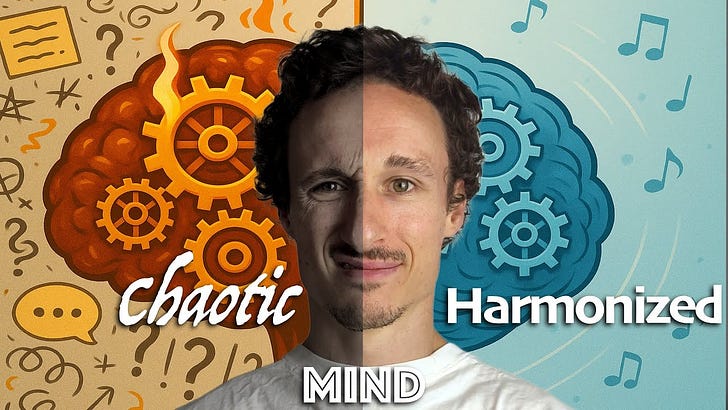
Harmonizing the Mind Through Action (You Got This)
I know this can all seem like a lot, but hopefully it’s also encouraging.
Hopefully you have a more clear idea of how you’ve gotten off track before, and are better equipped to to stay on track now.
If you want to do this- do it.
If not, it’s your choice. Accept it…
But if you’ve read this far, then there’s probably something inside you pulling you to flip this switch.
Remember that just closing ONE open loop is enough to reclaim mental bandwidth, affirm an identity of a person who finishes, and start a chain reaction of stacking wins- finishing project after project.
You have the list. You know the process.
Now it’s time to sort.
Go through your list. Separate micro from macro. Sort the macro loops into the five buckets.
The sorting doesn’t need to be a big drawn out process.
Don’t make it overwhelming.
Just do it quickly, even just in your head at first.
Doing it quickly is better than not doing it.
Find your ONE Loop.
Then ask yourself: What would closing this loop actually look like? Not perfectly. Just... closed.
And take the next step.
Because every closed loop is mental energy freed up. Attention defragmented. A step toward becoming someone who finishes what they start.
What’s Next
I’ve shared the process I’m using to close my six-year loop, and touched on some mindset shifts along the way.
But to me the mindset shifts are worth exploring way deeper.
The process alone isn’t enough.
Without certain mindset shifts, I’d still be stuck. Even with perfect organization and clear steps, I’d find ways to sabotage myself. I’m speaking from experience.
Next week, we’ll take a deep dive into the first set of mental reframes that made this process actually work for me. The shifts in how I think about my work, my identity, my REAL goals, and what “finishing” really means.
These mindset shifts are what transformed the process from “things I know I should do” to “things I’m actually doing.”
I’ll be sharing more of this journey as I go- both the music releasing weekly and the lessons I’m learning about harmonizing the mind.
The full Less Than Three album is releasing weekly.
Learn more about it in This Less Than Three Substack Post
Harmonize the Mind & Demystify the Ego Full YT Playlist
Love you,
Samuel